



Fast reading
- The next generation of generative and agentic AI has the potential to benefit both sustainability and development, driving efficiencies across a wide range of sectors that can significantly reduce resource use and emissions while helping deliver on key UN SDGs.
- However, the technology itself has a growing environmental footprint, and companies must manage its development and use to limit negative impacts. Renewables coupled with energy storage, water recycling and efficient datacentre design will all contribute.
- We believe investors play a crucial role in driving responsible AI through targeted company engagement.
As it rapidly evolves, artificial intelligence (AI) has huge potential to drive innovation and more efficient use of resources, boosting progress towards the United Nations Sustainable Development Goals (UN SDGs). However, AI is also set to become a major consumer of resources, making efficiency a vital focus of sustainable AI development.
AI: a double-edged sword?
Generative artificial intelligence (AI) opens up a world of opportunities to drive efficiency across sectors, improving both environmental sustainability and social outcomes. However, AI is extremely data-intensive, making it a growing consumer of resources.
As the volume of data created by digital activity grows exponentially, so does its impact on the planet, with data centres placing increasingly heavy demand on both electricity networks and water supply. So, what can be done to make the AI revolution part of a sustainable future?
The upside: significant efficiency gains and greater innovation
A recent study estimated AI could reduce global greenhouse gas emissions by the equivalent of 15% of current global emissions by 2035.
Figure 1: Overall progress against 139 UN SDG targets
In terms of specific goals, AI has the potential to drive faster and more accurate diagnosis and optimise operational and administrative aspects, as well as accelerating drug research while making it cheaper (SDG 3 Good health and wellbeing). For example, AI led to a 45,000-fold increase in the scientific rate of discovery of the three-dimensional structures of proteins, the functional building blocks of human cells.4
In manufacturing, AI can maximise productivity, minimise waste and downtime, reduce energy consumption and manage supply chain risk.5 This will help to address SDG 9 (Industry, innovation and agriculture) and SDG 12 (Responsible consumption and production). AI can also be leveraged in precision agriculture, helping to prevent loss of biodiversity — a key goal within SDG 15 (Life on land).
These are just some examples; similar benefits can be expected across a range of other sectors, including financial services, transportation and retail. In the longer term, AI will move on from streamlining existing processes to take on an increasing role in driving innovation — an important role given that research and development productivity is waning in sectors from chip making to agriculture.6
AI has the potential to boost innovation in three key ways: by increasing speed, volume and variety in designing prototypes and potential solutions; by accelerating the evaluation process through modelling; and by accelerating research operations. According to a 2025 report by global consultancy firm McKinsey, this has the potential to unlock US$360-560bn worth of annual economic value in large product companies.7
According to McKinsey, AI innovation has the potential to unlock US$360-560bn worth of annual economic value in large product companies.
The downside: heavy resource use
While the productivity and efficiency gains achievable through applied AI are significant for sustainability, the technology itself has a potentially high environmental cost.
The move to cloud-based systems has also helped to mitigate the environmental impact of growing data demand. Large ‘hyperscale’ data centres are significantly more energy-efficient than servers located on individual premises but, even so, the sheer volume of data employed to drive AI processes and the ‘always on’ nature of features such as chatbots and copilots is still driving overall resource use upward.
Datacentres were already responsible for around 1.5% of global energy-related greenhouse gas emissions in 2024.8 As the expected AI generative and agentic AI revolution takes hold, far more, larger data centres will be needed, requiring huge amounts of electricity for power and water for cooling.
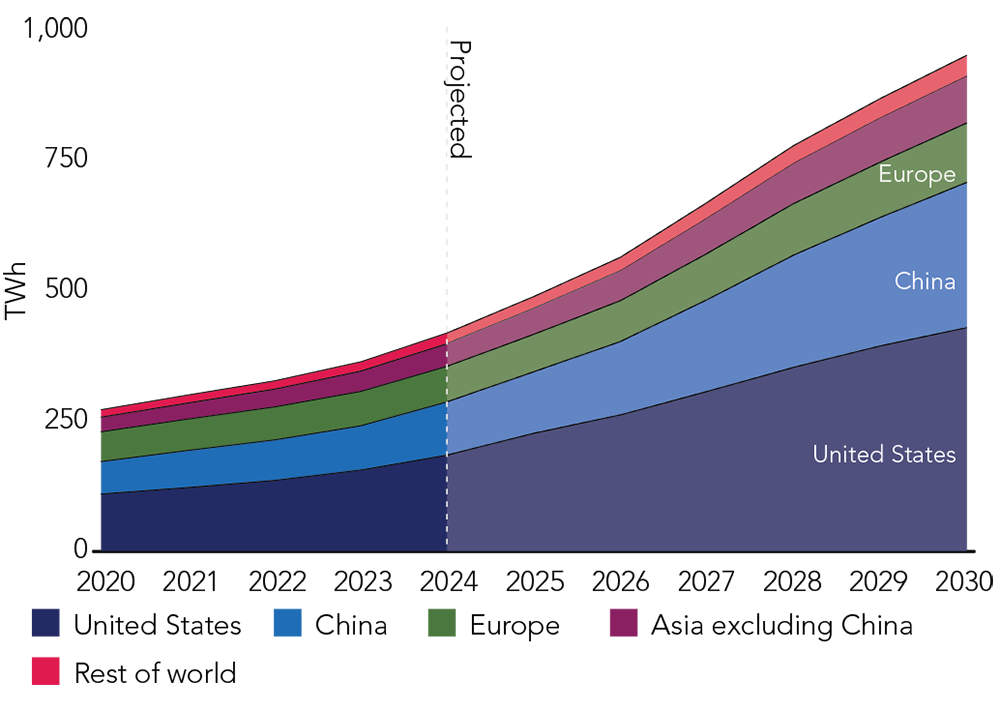
Under its Base Case scenario, the International Energy Agency (IEA) expects global electricity consumption from data centres to double to around 945 terawatt hours (TWh) by 2030 — more than the entire electricity consumption of Japan today.9 This additional electricity use will be heavily concentrated in areas of the US, China and to a lesser extent Europe (Figure 2).
Figure 2: Data centre electricity consumption by region, base case, 2020-2030
Data centre electricity consumption has grown by around 12% per year since 2017, more than 4x faster than the rate of total electricity consumption.
Servers generate more heat and are more densely packed as required processing power increases, making efficient cooling essential. Water has up to 3,000 times the heat absorption capacity of air; it has therefore rapidly become the default cooling option.
The average datacentre using 300,000 gallons of water a day, equivalent to water use in 1,000 homes,10 and the IEA estimates datacentre water use will more than double by 2030 to nearly 1,200 billion litres.11 If facilities are built in regions where water stress is already an issue, the risk of drought can even be amplified. However, water usage disclosure has historically been poor and investors are often not properly informed of the issues.
Together, these factors make rapidly growing AI use a major issue in terms of both SDG 6 (Clean water and sanitation) and SDG 7 (Ensure access to affordable, reliable, sustainable and modern energy for all).
By 2030, the IEA expects global electricity consumption from data centres to be more than the entire electricity consumption of Japan today.
The solution
A number of tech companies are already making strong progress on resource efficiency.
Some purchase renewable energy through long-term power purchase agreements (PPAs), enabling power companies to plan and finance future development. Others are investing in their own renewable generation and/or battery storage facilities. For example, Microsoft recently signed a US$6bn deal with an AI infrastructure project in Norway that will be powered by 100% renewable energy.12
Microsoft have also partnered with Swedish multinational energy company Vattenfall on tech that ensures 24/7 delivery of renewable energy to their Swedish data centres. The solution, which matches instantaneous energy demand with immediately available renewable supply, has also been launched as a commercial product.13
Energy efficiency is also a focus, with TSMC using AI-powered software itself to design a new generation of chips that are ten times more energy efficient.14
Solutions to reduce water use and impact include closed-loop systems that recirculate water for cooling, AI-driven leak detection, and non-potable water sources. Microsoft’s new generation of data centres use chip-level cooling solutions to deliver precise temperature control without water evaporation, effectively consuming zero water.15
Unfortunately, not all tech companies acknowledge and aim to act on environmental impact equally. Investors therefore need to be diligent in assessing the quality of disclosures, progress made and potential risks, driving change through meaningful, targeted engagement.
As an adviser on more than US$2.3tn in assets through our EOS16 stewardship services, Federated Hermes is well placed to engage with the big tech firms, who are otherwise unreachable for most investors. Through dialogue with companies and policymakers on governance and strategy, we aim to shift the dial on relevant and material issues, including resource use and emissions.
We have developed a proprietary Responsible AI Assessment Framework to assess companies’ ‘Responsible AI Maturity’. This considers whether a firm’s AI use cases present strategic, operational or risk management opportunities (or threats), and whether these risks are limited, minimal or high. Subsequent analysis also considers a company’s knowledge of AI, how its workflows and processes can mitigate risk, and the extent to which its oversight and disclosures demonstrate effective compliance.
Sustainable Global Equity, Annual Report 2025
For more information on Sustainable Global Equity.
This document does not constitute a solicitation or offer to any person to buy or sell any related securities or financial instruments. The value of investments and income from them may go down as well as up, and you may not get back the original amount invested. Any investments overseas may be affected by currency exchange rates.
1 Source: https://www.nature.com/articles/s44168-025-00252-3
3 https://unstats.un.org/sdgs/report/2025/The-Sustainable-Development-Goals-Report-2025.pdf
4 https://www.iea.org/reports/energy-and-ai/ai-for-energy-optimisation-and-innovation
5 Source: https://blogs.sw.siemens.com/tecnomatix/ai-in-manufacturing-transforming-engineering-production-and-supply-chains/
6 Source : https://www.mckinsey.com/capabilities/quantumblack/our-insights/the-next-innovation-revolution-powered-by-ai
7 Ibid.
8 Source: https://www.iea.org/reports/energy-and-ai/energy-demand-from-ai
9 Source: https://www.msn.com/en-us/money/companies/water-usage-by-ai-data-centers-raises-supply-concerns/ar-AA1LpMq9
10 Source: https://www.iea.org/reports/energy-and-ai
11 Ibid.
14 Source: https://www.reuters.com/world/asia-pacific/tsmc-chip-design-software-firms-tap-ai-help-chips-use-less-energy-2025-09-25/
15 Source: https://www.microsoft.com/en-us/microsoft-cloud/blog/2024/12/09/sustainable-by-design-next-generation-datacenters-consume-zero-water-for-cooling/
16 EOS at Federated Hermes Limited, as at 31 December 2025.
BD017354