



1. What’s the fund’s focus?
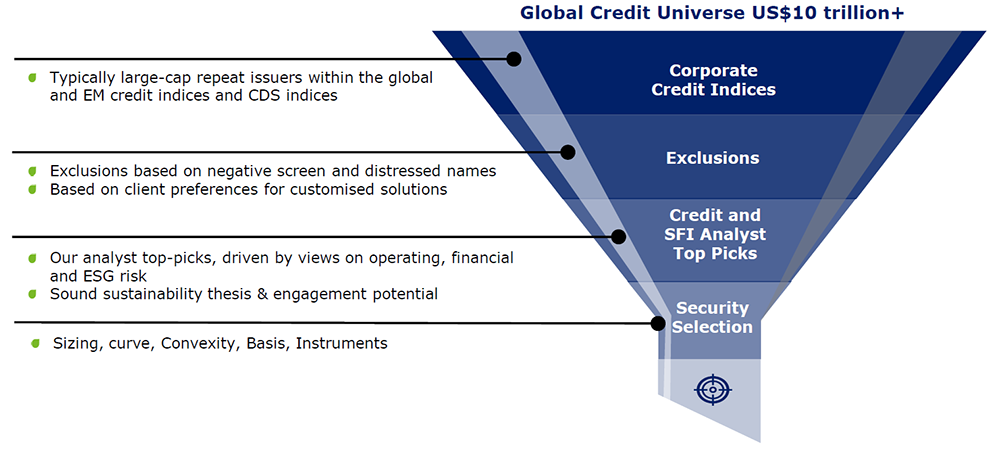
The Federated Hermes Sustainable Global Investment Grade Credit Strategy invests in global investment‑grade corporate bonds issued by companies that demonstrate either sustainability leadership or credible improvement trajectories.
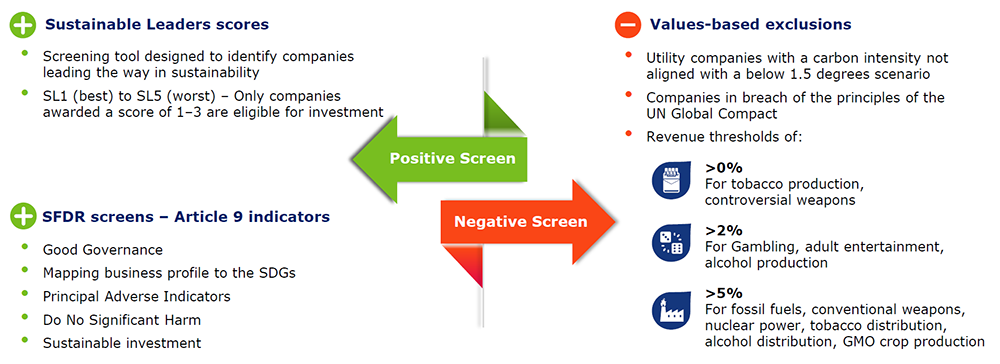
We build the investable universe using a combination of values‑based exclusions and positive sustainability screening. We exclude issuers involved in activities inconsistent with the strategy’s objectives, while eligible companies must score between SL1 and SL3 under Federated Hermes’ proprietary Sustainable Leaders framework.
From this filtered universe, portfolio managers apply fundamental credit analysis and relative‑value assessment across regions, curves and capital structures. The strategy is benchmark‑agnostic, allowing capital to be allocated where we see the most compelling risk‑adjusted opportunities, while remaining focused on liquidity and investment‑grade quality.
Figure 1: Screening the global credit universe
2. What's the strategy trying to achieve and how do you define success?
The strategy has a dual objective:
- to deliver a positive total return over a rolling five‑year period, and
- to do so with a lower environmental footprint than the benchmark.
This sustainability objective is binding, not aspirational. Environmental metrics—including carbon emissions, water usage and waste intensity, normalised per unit of investment—are integrated into portfolio construction and ongoing monitoring alongside traditional credit risk measures.
Reflecting this commitment, the strategy is classified as SFDR Article 9.
Figure 2: How we apply our engagement and sustainability expertise
3. Why sustainable investment grade credit and why now?
Investment‑grade credit plays a central role in portfolios, offering scale, liquidity and diversification, alongside more defensive characteristics than lower‑quality credit. Higher yields and improved all‑in income have strengthened its return potential in recent years.
At the same time, sustainability factors increasingly shape credit risk itself. Regulation, technological change and shifting consumer preferences are accelerating the transition to lower‑carbon and more resource‑efficient business models. For credit investors, this creates clear differentiation between issuers that adapt – and those that don’t’.
Companies that fail to manage environmental and social risks face rising financing costs, regulatory pressure and heightened downgrade risk. Those that invest credibly in transition pathways are more likely to benefit from resilient cash flows, stronger balance sheets and more stable access to capital markets.
We invest in companies positioned to benefit from the economy’s structural shift towards sustainability—driven by regulation, changing consumer behaviour and evolving value chains.
4. Where can the strategy add compared with traditional credit approaches?
Our starting point is the conviction that sustainability factors are financially material in credit markets. Weak governance or poor management of environmental and social risks can accelerate credit deterioration; strong and improving practices can enhance balance‑sheet resilience and downside protection.
The strategy combines top‑down macro and risk‑appetite assessment with bottom‑up issuer selection. At the macro level, we assess economic conditions, valuations and relative value across regions and curves. At the issuer level, we integrate fundamental credit research with proprietary sustainability analysis, including ESG scores, Sustainable Leaders assessments and engagement insights.
A key differentiator is the depth of Federated Hermes’ credit and stewardship platform. Portfolio managers, credit analysts and sustainability specialists work closely together, supported by the firm’s engagement capabilities, to identify mispriced credit risk and sustainability‑related opportunities across the global investment‑grade universe.
5. How do you implement the sustainability objective in practice?
Sustainability is embedded throughout the investment process. The Sustainable Leaders framework assesses both issuers’ current sustainability profiles and their direction of travel, capturing momentum as well as absolute performance. Laggards are excluded; leaders and credible improvers are eligible.
The strategy also applies values‑based exclusions and aligns with SFDR Article 9 requirements, including consideration of principal adverse impact indicators and “do no significant harm” criteria.
Engagement is integral. Ongoing dialogue with issuers focuses on disclosure, governance and tangible progress on environmental and social issues. These insights directly inform investment decisions and our assessment of long‑term credit risk and opportunity.
By integrating sustainability analysis, engagement and fundamental credit research, the strategy aims to deliver attractive risk‑adjusted returns while achieving a measurable reduction in environmental impact relative to the benchmark.
Sustainable Global Investment Grade Credit: Five questions
BD0020046